As luck would have it there was a market in Fecamp the day after we arrived, luck or maybe Chas had considered this in his passage planing.
Why I Love Fecamp
by Angela
Fecamp is one of my favourite destinations along the Normandy coast . This vibrant little port with its friendly atmosphere and quiet dignity never fails to turn up some new side of itself every time we visit .It is mainly a seaside resort now with an active town centre , marina , casino, numerous good restaurants and two excellent markets a week, of which more later, but just dig a little way under the surface and some real gems and a rich history emerges!
Legend has it that the trunk of a fig tree containing the precious blood of Christ collected by Joseph of Arimathea was washed ashore on the river bank and this gave the settlement its name Fici-Campus. This relic attracted many medieval pilgrims adding to the importance and financial status of the city.
There has been a settlement there since Neolithic times and it was an important settlement back as Roman times and reached its zenith in Medieval time with herring fishing. Latterly it was the home port of the Newfoundland cod fishing fleet. That was a very hazardous way of life and the cost of human life was dear as the ships braved the arctic conditions. Thus the soul of Fecamp has always been centred on the lives and toils of fisherman and sailors. Nowhere is this more evident than on a visit to the fishing museum originally housed on the seafront but now being moved to a new location in the middle of the old fishing port. There one can see the tools of the trade and how they evolved over the ages as well as scale models of various types of craft.
On the sea front in front of the old museum is a simple rough hewn statue of a windswept fisherman’s wife or mother wrapped in a shawl and wearing her clogs looking out to sea seeking the return of her men folk. The fact that it is rough hewn seems to represent the grit and dignity of the community and is one of the most moving and symbolic memorials that I have come across.
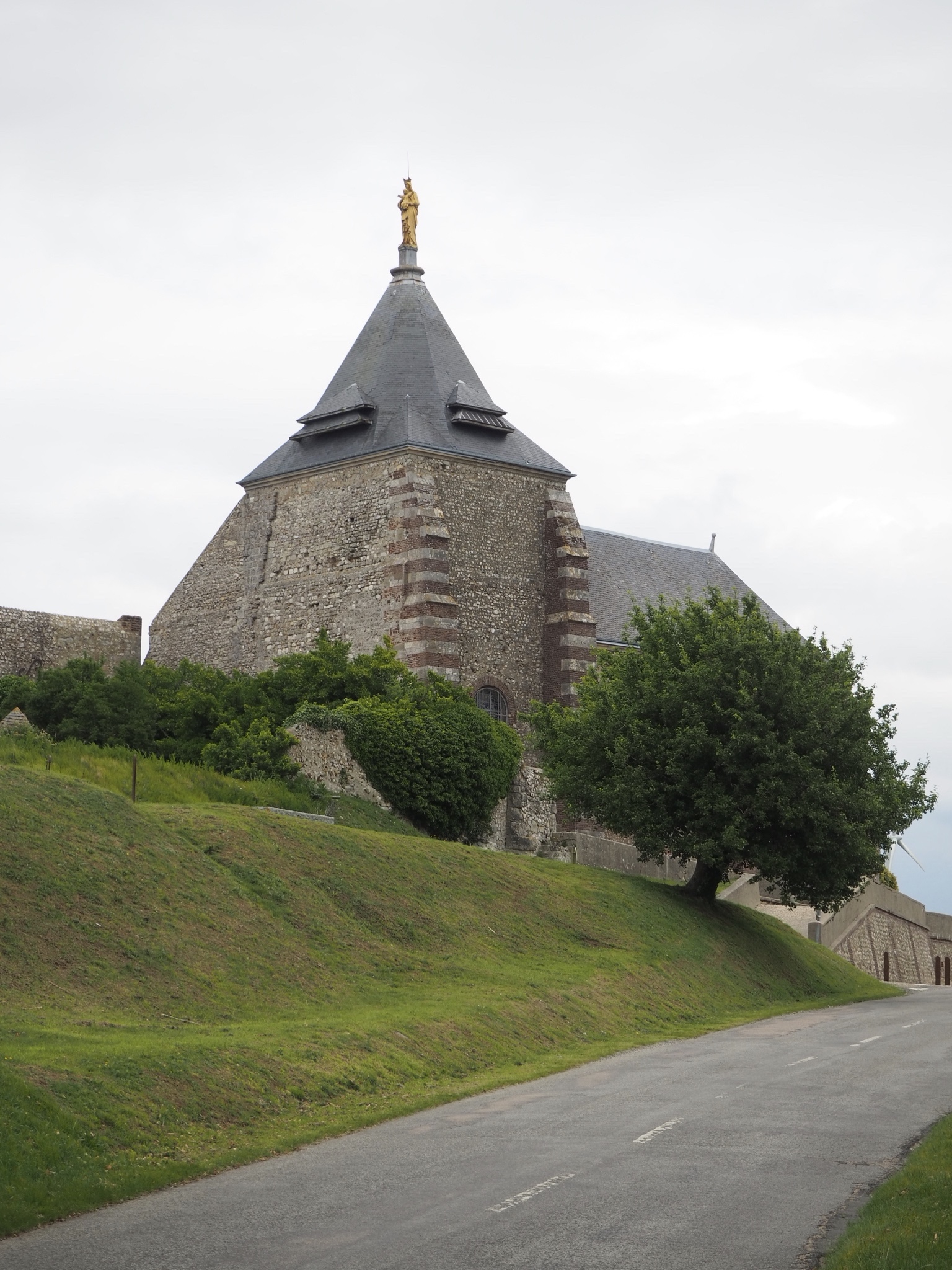
Seafarers are religious folk and in every major port has its sailors chapel Fecamp is no exception . Our lady of Salvation chapel is set high on a hill overlooking and protecting the town.
It is reached by a pilgrims way consisting of a series of steep stone steps up the hillside from the quay which you can still climb today.
The pilgrims are said to have often mounted these steps on their knees to plead for the safe passage of a ship at sea or the return of a loved one. If you look carefully you can see names etched into some of the steps.
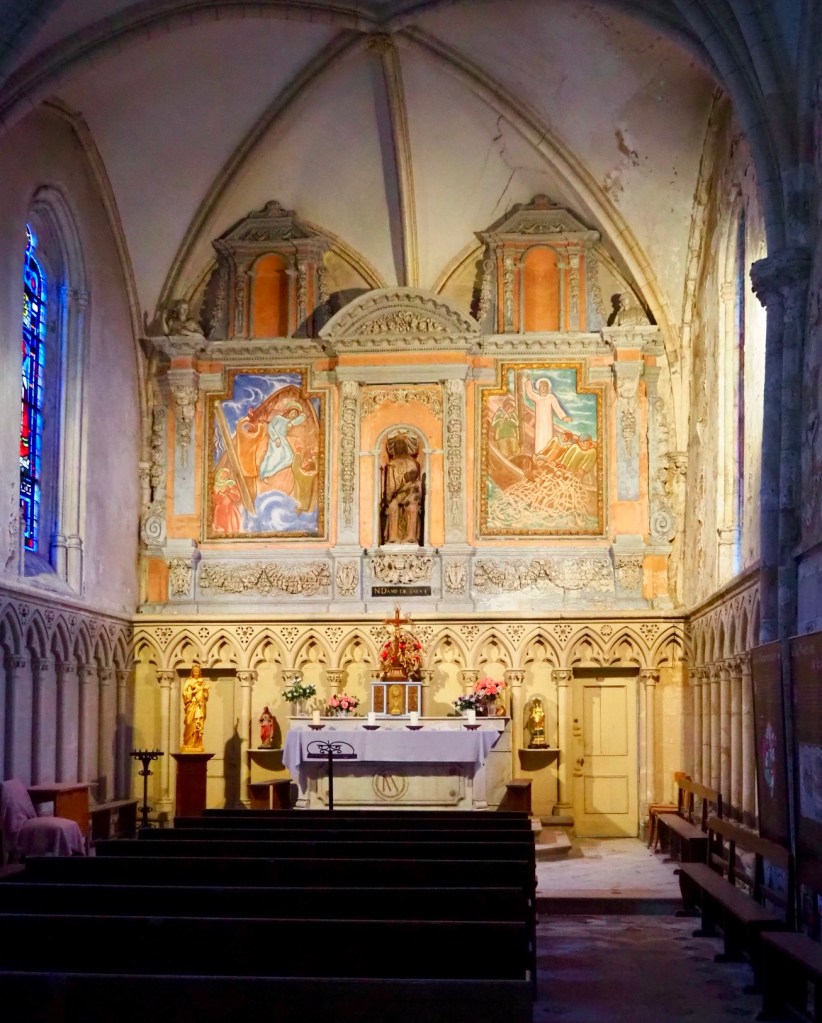
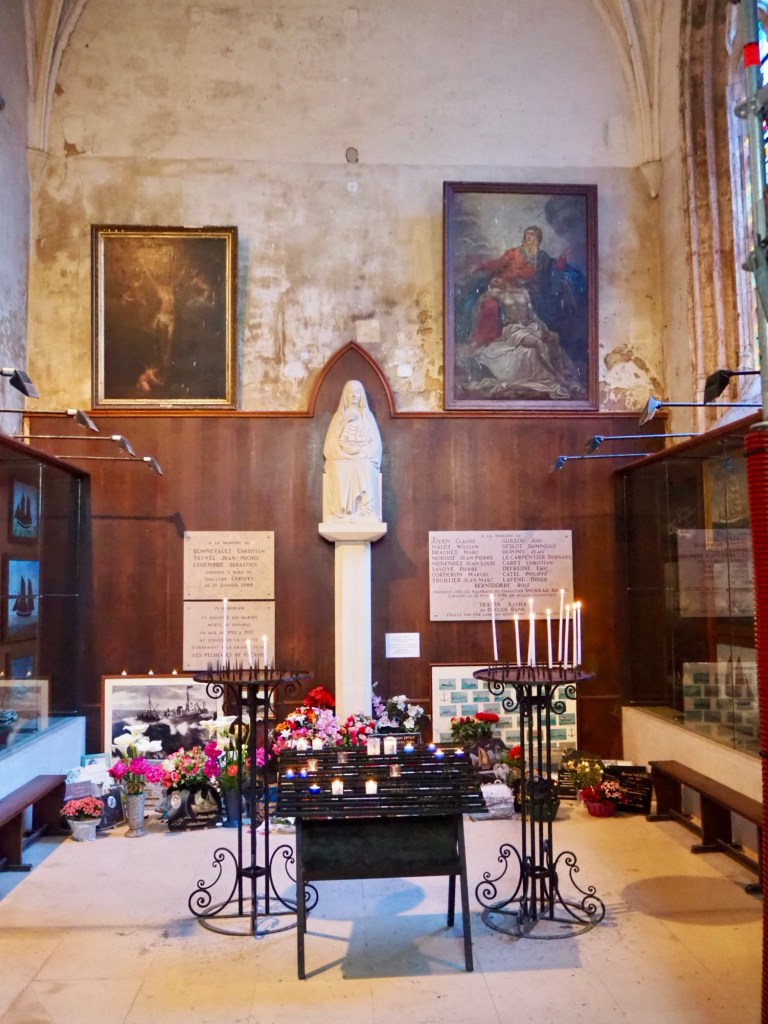
The chapel is beautiful, very simple, tranquil and contains numerous paintings of ships that left from Fecamp some sadly never to return There are many votive offerings for the souls lost and plaques of thanks to Our Lady for those safely returned home.
It is a great place to spend a little time in quiet reflection.
In stark contrast Next to the chapel on Cap Fragnet as that part of the cliff is called is the Semaphore where a large radar station was built in 1942 and surrounding that the menacing looking Blockhouse of the Atlantic Wall which was a main defence position for the Germans in WW2 from 1940-1942.
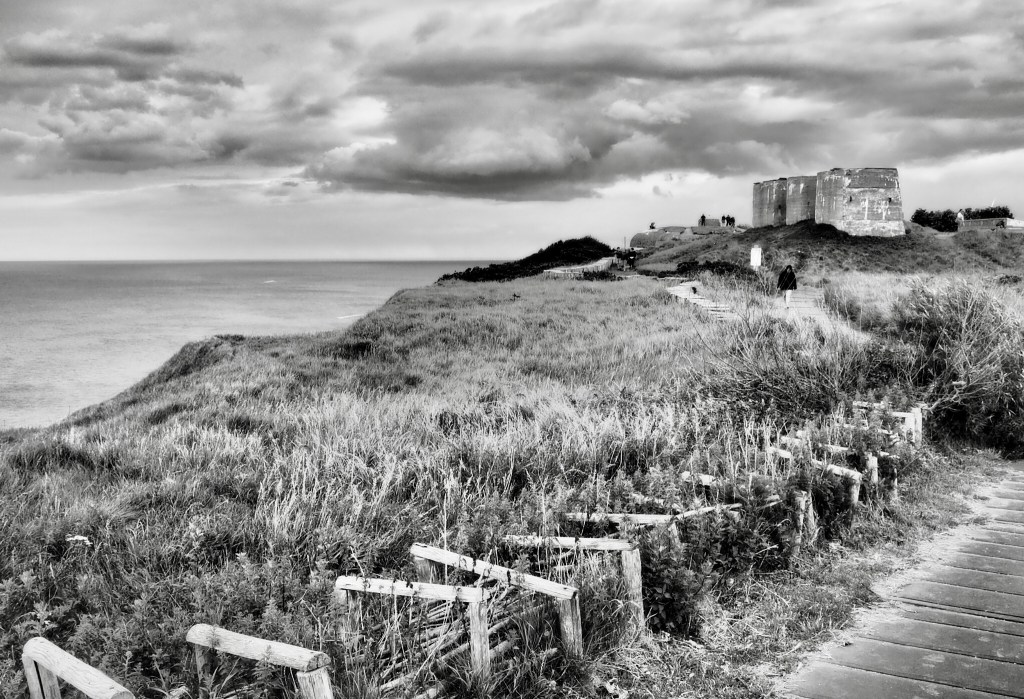
From here there are commanding views of the cliffs up towards Dieppe and down over Fecamp as far as the Etretat cliff stacks made famous by the Impressionist painters.
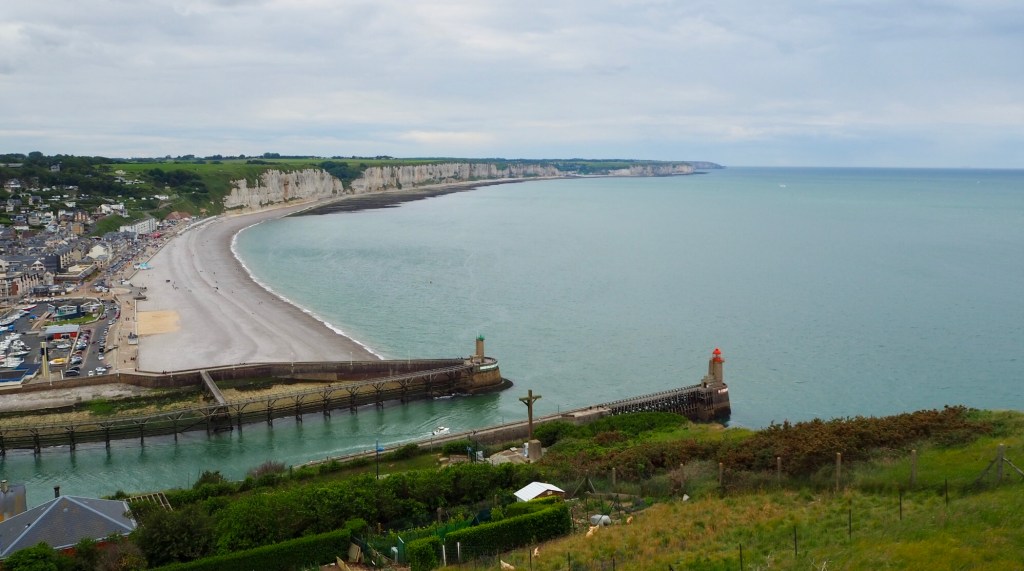
The walks along these cliff tops are really most spectacular and there is a good bus service to and from the lovely quaint village of Yport so you only have to walk one way! There are several teashops and restaurants to reward your efforts once you get there.
For those seeking less exhilaration, a gentle stroll down the river valley to Ganzeville and back up the hill and across the fields with its views of pastures and the abbey is a delight, and definitely deserving of a beer in the main square on the way back to the Marina.
Fecamp was homes to the dukes of Normandy the original castle built by William 1stof Normandy and current remains of the castle are those built by Henry 2nd Plantagenet in 12 century can be seen. It was here that William the Conqueror celebrated Easter with his followers following his victory at Hastings in 1066.
As Fecamp was a place of pilgrimage an abbey for nuns was built in 7 century and the current gothic building is 12 century. One of my favourite churches It is an impressive light airy yet serene building with a nave longer than that of Notre Dame in Paris and beautiful set of cloisters. It is noted for the tabernacle of the holy blood, the decorative screens around the alter as well as several important works of Renaissance art,. Often it houses individual exhibitions, but for me the atmosphere and majesty of the building itself is the focal point.
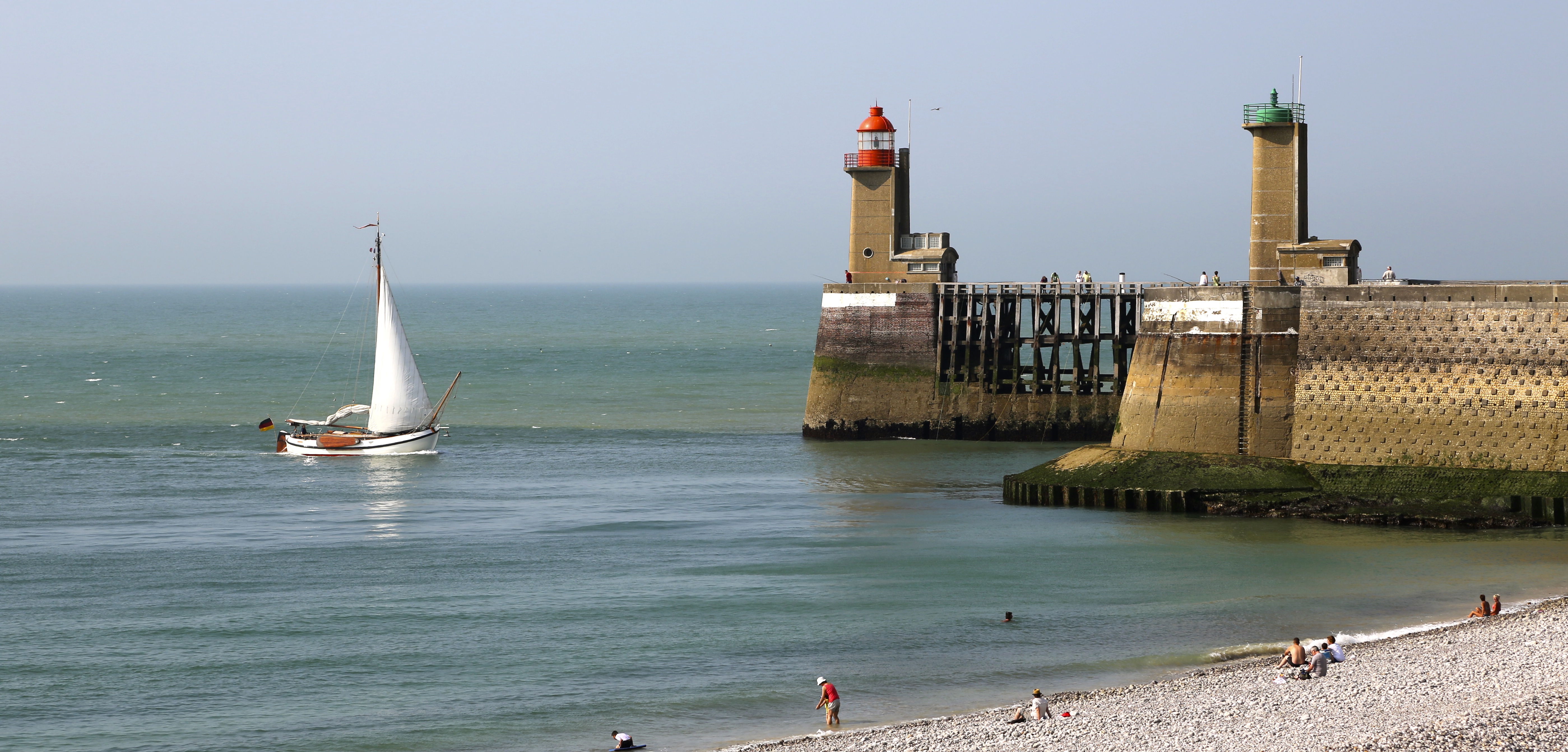
Coming in from the sea the entrance piers are usually lined with “Les Pecheurs” fishing in almost all weathers casting fishing lines down on unsuspecting yatchtsmen and the skyline shows the well marked and impressive Gothic spire of the Benedictine Palace. I was really excited about this and was expecting an amazing Benedictine abbey steeped in history ,but no, this was built by Alexander Le Grand a wine merchant and industrialist originally in 1863 again in1900 following a fire, is totally dedicated to Benedictine liqueur!
The story goes that LeGrande was a collector of religious art and artefacts and amongst his collections he found a recipe for a secret elixir said to have been concocted by a Benedictine monk at the Fecamp abbey in 1510. With the help of a pharmacist, he recreated this elixir and called it Benedictine. The Palace is a glorious totally over the top edifice which houses a small museum of Legrands artefacts .The Liqueur is no longer made there but you can see the old distillery and the exhibition that tells the story of the origins of the spices and herbs ( though sadly not the proportions) that are used is really informative .This together with the history and marketing of the product over the years makes for an interesting tour, but not a monk in sight. The carrot of course is the sample taste at the end ,but more importantly is the opportunity to buy black label Benedictine which is not exported and very much tastier and stronger than the drink that we are used to.
In the same vein One must mention Cave Berigny on the quay front by the marina which is an extraordinary wine merchant with an excellent range of well priced as international as well as French wines , not to mention an encyclopaedic knowledge of all the different styles of Calvados the apple liqueur of Normandy.
If you need yet another indulgent treat there is a chocolate museum in town !
French markets
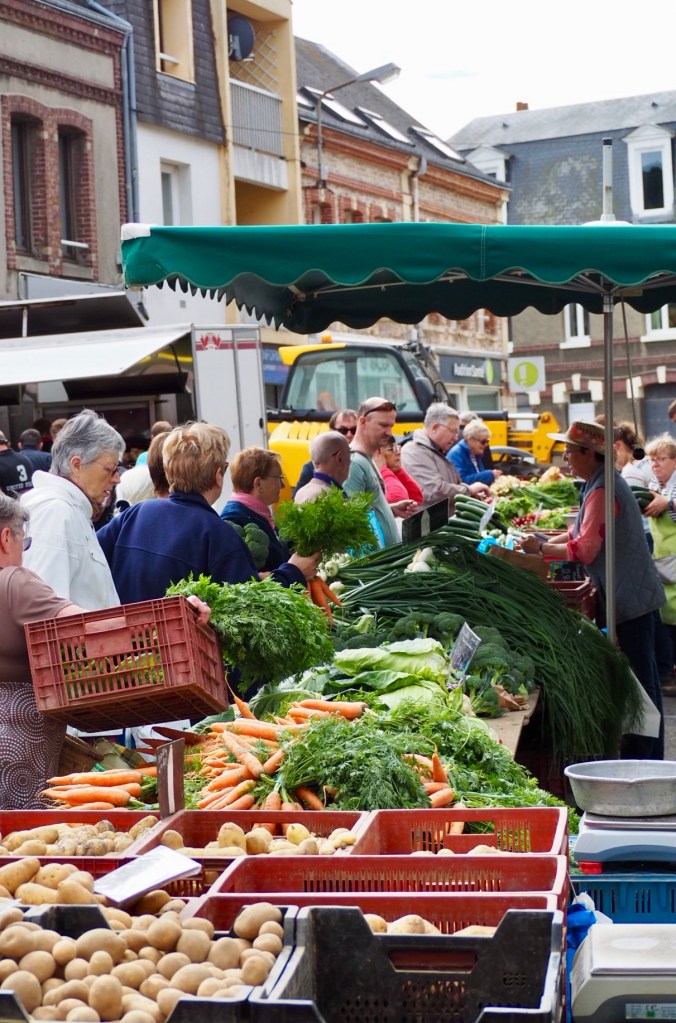
Ah! French markets….
Planing sailing trips is hard enough,what with tides,weather & wind etc. In France the most important part is when is market day?
All French towns have at least one market day a week, and the plan is to cram in as many as possible.
So, here we are at Fecamp for the Saturday market ( pure coincidence).
There is the usual array of fish,fruit & veg. The peaches taste of peach, the lettuces were grown in soil,not water & the tomatoes are ripe and full of flavour.
Don’t get me started on melons…..
There is seafood, Cheese, bread, honey, a large clothing and haberdashery area and the covered farmers market.
Here you can find wonderful unpasteurised dairy products ( all low fat of course). Eggs, veg and all kinds of poultry, all of which have clearly led happy lives in the great outdoors.
We came back to the boat a fine pintade ( guinea fowl), a pot of norman cream and a generous slab of butter. See the next instalment for the joyous amalgamation of all three.
Cuisine Francais – lesson 3
Le Pintade
When we are in Fecamp, a fine norman town with a wonderful old abbey, the home of Benedictine, and a excellent saturday market….
Although Fecamp is no slouch when it comes to fresh fish and seafood, it was time for a change. Fecamp market also has a covered area where the local farmers sell their produce including wonderful tasty farm chickens, ducks and pintades, as well as the amazing local unpasteurised dairy produce and much more.
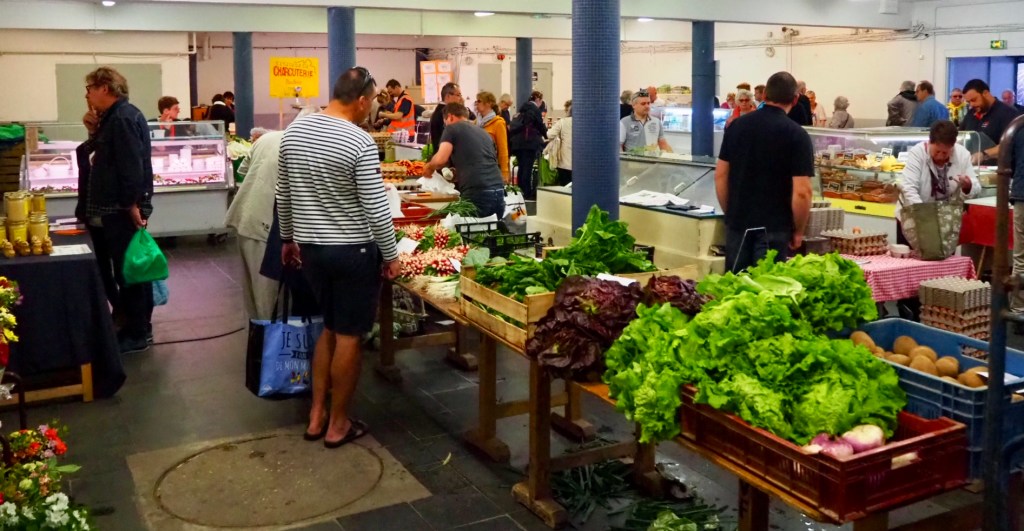
Anyway, here we acquired our Pintade, ( guinea fowl in English) together with a pot of norman cream & butter ( don’t worry they live longer than the English).
Ok – so we have the guinea fowl in England, right? you can get them in waitrose. Indeed, you can, and they are not bad, but those bought direct from the farmer at a french market always have more flavour and character.
Now , the next bit has another warning for the squeamish, most fowl in France come with their heads attached…..
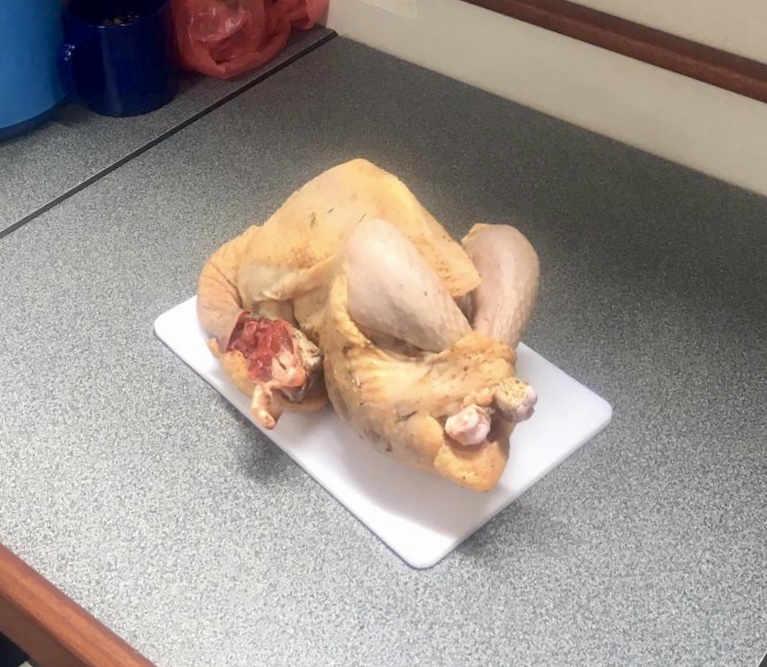
This is because no self respecting French cook would prepare a bird for the table without making the proper giblet stock for the sauce. This is sadly an almost lost skill in England, when most birds are sold with no giblets at all incroyable!!!
Here as well as the head and neck, there are also the gizzard, heart and liver. Into the pot they go (except the liver, which can sometimes have some bile taint). With some onion, carrot, herbs and covered with water. Simmer for as long as possible ( at least 2 hours).
The bird itself is generously seasoned with salt, and an equally generous amount of butter, and cooked in a high gas oven on each side for about 1 11/2 hours depending on size. After it has browned, turn the oven down to about half. it can then be kept going for a further half hour or so on a low heat if necessary.
It is cooked when the legs move freely against the carcass, and juices run clear.
While the bird is resting, stain your stock, add a good dollop of cream and reduce. There is your sauce.
Fresh herbs are good, Wild mushrooms are heavenly…..
16th June 2019
The time had come and we had to move on, the Brits sail to Le Havre, but with a fairly lively sw force 5 we didn’t think that was a great move, so we decided to opt for the Dutch approach, straight for Cherbourg. It was an early start according to the passage plan, possibly in the dark, so after a few drinks during the planing meeting, we talked Chas into leaving an hour later – What a mistake.
We slipped our lines at 0600hrs, and went out to sea with the protection of the coast the force 5 sw wind didn’t appear to be that bad. As soon as we reached open sea it was a little bit different, we all put 2 reefs in and close hauled,as the script always goes Shades of blue took off like a train, leaving Lily and Escapade in her wake.
After 3 hours of crashing about it all seemed to settle down, Shades still miles ahead, but at least the voyage was now comfortable. As the day went on the wind started to move slightly wsw, really tough for Lily and Escapade, and even pushing Shades further of course than she would liked, with the added problem of the Ouistreham ferry and two container ships motoring towards us at Barfleur, the passage plan went totally to pot, with all boats reaching the Base du Renier cardinal with +3kts of tide to -5 kts in what felt like minutes. Of course it then took hours to complete the final part of the journey, as Chas says “ho hum”. to add to Lily’s problems the alternator diode, which has been an on off problem for years started to play up causing the engine battery to severely overheat. Battery disconnected and journey finally complete we arrived in Cherbourg 2130hrs, a long day with 98nm travelled through the water. Don’t ever listen to a Dutchman…

 Cruising to Brittany